
How Navratri and Dussehra Are Celebrated in a Gated Community
Few things lift the mood of a neighbourhood like the nine nights of Navratri. The beat of the...
Read More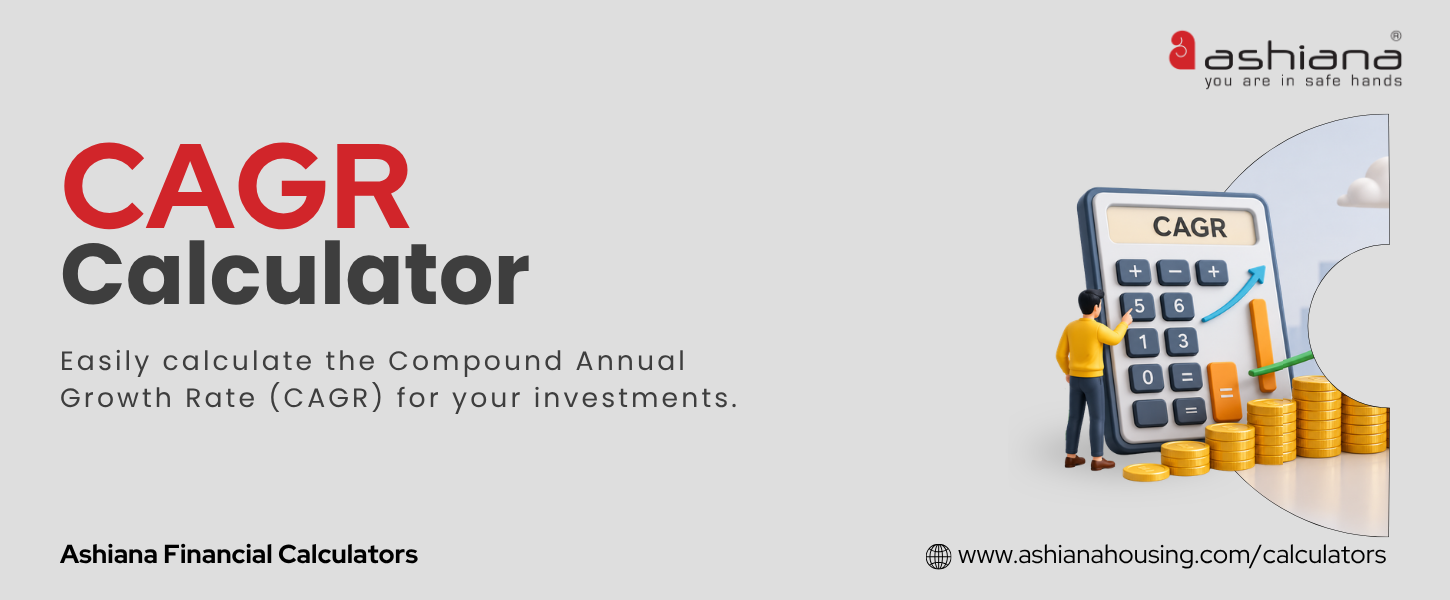

In today’s fast-changing financial landscape, understanding investment performance has become more important than ever. Whether you are evaluating mutual funds, stocks, real estate, or business growth, a reliable CAGR Calculator can help simplify complex return calculations and provide a clearer view of long-term performance. As investors increasingly focus on data-driven financial planning in 2026, CAGR continues to remain one of the most trusted metrics in financial analysis.
The term compound annual growth rate, or CAGR, refers to the average annual growth rate of an investment over a specific period, assuming the profits are reinvested every year. In simple words, it smoothens out fluctuations in returns and gives a consistent annual growth percentage.
For example, an investment may generate 25% returns in one year and only 8% in another. Instead of showing this volatility, CAGR presents a single annualized growth rate that reflects the overall performance over time.
This is why financial analysts, investors, and businesses widely use CAGR for evaluating long-term growth.
Understanding what is CAGR is essential because it provides a realistic picture of investment performance over multiple years. Unlike simple return calculations, CAGR considers compounding, making it more accurate for long-term financial assessment.
As investment markets become increasingly dynamic in 2026, CAGR remains a valuable tool for making informed decisions.
The standard CAGR formula is:
CAGR = (FV / PV)^(1/n) – 1
Where:
This formula calculates the annualized growth rate while accounting for compounding effects.
Let’s assume:
CAGR = (10,00,000 / 1,00,000)^(1/5) – 1 = 0.589 or 58.9% annually
This means the investment grew at an average annual rate of 58.9%, assuming the returns were compounded each year.
One of the biggest advantages of CAGR is that it allows investors to compare completely different investment avenues on a common scale.
For instance, you can compare:
This helps investors identify the best-performing asset classes based on historical growth.
Mutual fund investors frequently use CAGR to assess scheme performance over 3-year, 5-year, or 10-year periods.
Instead of focusing on short-term fluctuations, CAGR highlights the overall growth trend of the investment.
Businesses also use CAGR to analyze:
It provides a structured way to measure long-term business performance.
4. Financial Goal Planning
CAGR is extremely useful in future financial planning. Investors can estimate the required return rate needed to achieve a target corpus within a specific timeframe.
This makes it highly relevant for:
Understanding CAGR examples helps investors use the metric more effectively.
For example:
In all these situations, CAGR helps determine the average annual growth performance despite yearly market ups and downs.
Although CAGR is widely used, it is important to understand its limitations before relying on it entirely.
CAGR smoothens annual returns, which means it may hide sharp market fluctuations or negative yearly performance.
If investments involve regular withdrawals or periodic contributions, CAGR may not provide accurate insights because it assumes a lump-sum investment structure.
CAGR focuses only on returns and does not consider the level of risk involved in achieving those returns.
Therefore, investors should use CAGR alongside other financial metrics for balanced decision-making.
In 2026, digital financial tools are making investment analysis faster and more accessible. A modern CAGR Calculator helps users instantly calculate growth rates without complicated formulas or manual effort.
For investors looking for a simple and practical solution, the Ashiana Housing CAGR Calculator offers an easy way to analyze long-term investment growth and evaluate financial performance efficiently. It can be particularly useful for comparing property appreciation trends, wealth creation strategies, and long-term investment planning.
The compound annual growth rate remains one of the most effective metrics for evaluating long-term investment performance in 2026. Whether you are comparing mutual funds, analyzing stock returns, or planning future financial goals, understanding what CAGR is and using a reliable CAGR Calculator can significantly improve your financial decision-making process.
However, while CAGR simplifies growth analysis, investors should also consider volatility, risk, and market conditions before making investment decisions. When used correctly, CAGR becomes a powerful financial analysis tool that supports smarter and more informed investing.
Disclaimer: This article is for general informational purposes only. The views expressed are those of the author and may not reflect the official views of Ashiana Housing Limited or its affiliates. Any calculations or explanations shared are indicative and should not be treated as financial, legal, or investment advice. Readers should consult professionals before making financial or property-related decisions.
CAGR or Compound Annual Growth Rate is the average annual growth rate of an investment over a specific time period while considering compounding.
CAGR is calculated using the formula: (Ending Value / Beginning Value)^(1/N) – 1
CAGR helps investors compare different investment opportunities and understand long-term growth performance more accurately.
CAGR does not reflect market volatility, ignores investment risk, and may not work accurately for investments with multiple cash flows.
Yes, a CAGR calculator online helps users instantly calculate annualized growth rates without manual calculations.