How Infrastructure Development Is Transforming Gurgaon’s Real Estate Market

Over the past twenty years, Gurgaon has transformed from a quiet extension of Delhi into one of India’s fastest-growing urban centres. While the rise of multinational companies and the IT sector certainly accelerated its expansion, the true force reshaping the city’s landscape has been large-scale infrastructure development.

From expressways and metro corridors to elevated roads and smart utilities, infrastructure development has redefined how people live, commute, and invest in the Gurgaon real estate market. Let’s examine how each layer of urban infrastructure influences property values and real estate trends throughout the city.

How Infrastructure Development Is Transforming Gurgaon’s Real Estate Market

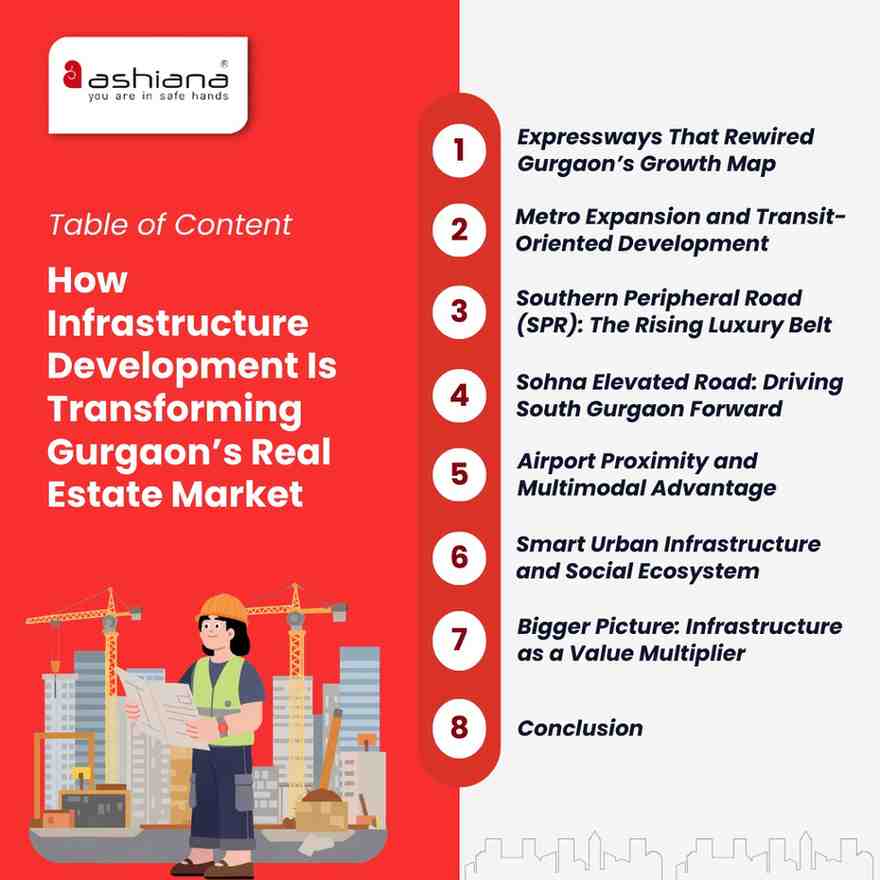
Expressways That Rewired Gurgaon’s Growth Map


NH-48: The Economic Backbone


National Highway 48 (formerly NH-8) connects Delhi to Jaipur via Gurgaon and Manesar. More than just a transport corridor, it acts as the commercial spine of the city.

Impact on Gurgaon real estate:

  • Office clusters flourished along the highway, especially in Cyber City and Udyog Vihar.
  • Residential sectors near the corridor saw steady rental demand from professionals.
  • Manesar developed into a logistics and industrial hub due to seamless connectivity.

Recent flyovers and traffic upgrades have eased congestion at key junctions, strengthening buyer confidence in nearby residential pockets. Accessibility continues to be a pricing advantage in the Gurgaon property market.

Dwarka Expressway: The New Investment Magnet


Dwarka Expressway has emerged as one of the most talked-about infrastructure projects in NCR. This 29-km corridor connects Dwarka in Delhi to Gurgaon’s northern sectors.

Why it matters:

  • Offers an alternate route to NH-48, reducing travel dependency.
  • Improves access to the IGI Airport and upcoming convention hubs.
  • Unlocks land parcels in Sectors 102-113 and 84-95.

Premium residential developments and mixed-use projects have accelerated along this stretch. Investors, including NRIs, are closely tracking price movement here as infrastructure development reaches completion.

Metro Expansion and Transit-Oriented Development


Modern urban infrastructure is incomplete without strong public transport, and Gurgaon’s metro network has reshaped housing preferences.

Delhi Metro: Redefining Daily Commute


The Delhi Metro connects Gurgaon through the Yellow Line, providing seamless access to central Delhi from HUDA City Centre. This connectivity has significantly strengthened the local property market, driving higher rental demand near metro stations, improving occupancy rates for walk-to-metro apartments, and boosting commercial leasing along key corridors like MG Road and Golf Course Road. For many homebuyers today, metro access is no longer an added benefit; it is a primary decision-making factor.

Rapid Metro: Strengthening Corporate Corridors


Rapid Metro Gurgaon supports internal mobility between CyberHub and Golf Course Road.

Areas like DLF Phase 2, Sector 42, and Sector 54 benefit from:

  • Faster commute to office clusters.
  • Stronger resale value.
  • Improved tenant retention.

Upcoming metro corridors proposed by Haryana authorities are expected to further integrate Old Gurgaon, SPR, and New Gurgaon, extending infrastructure development deeper into emerging sectors.

Southern Peripheral Road (SPR): The Rising Luxury Belt


Southern Peripheral Road is emerging as one of the most influential growth corridors in South Gurgaon. Stretching nearly 16 km, it connects Golf Course Extension Road to National Highway 48 while linking several newly developed residential sectors. Its rapid rise is driven by close access to reputed schools and hospitals, strong connectivity to major business hubs, and future integration with the Dwarka Expressway and expanding metro network, making it a strategic location in the evolving Gurgaon property market.

Over the past few years, the SPR belt has attracted high-rise luxury apartments, mid-income projects, and plotted developments. Price appreciation here reflects confidence in long-term urban infrastructure planning.

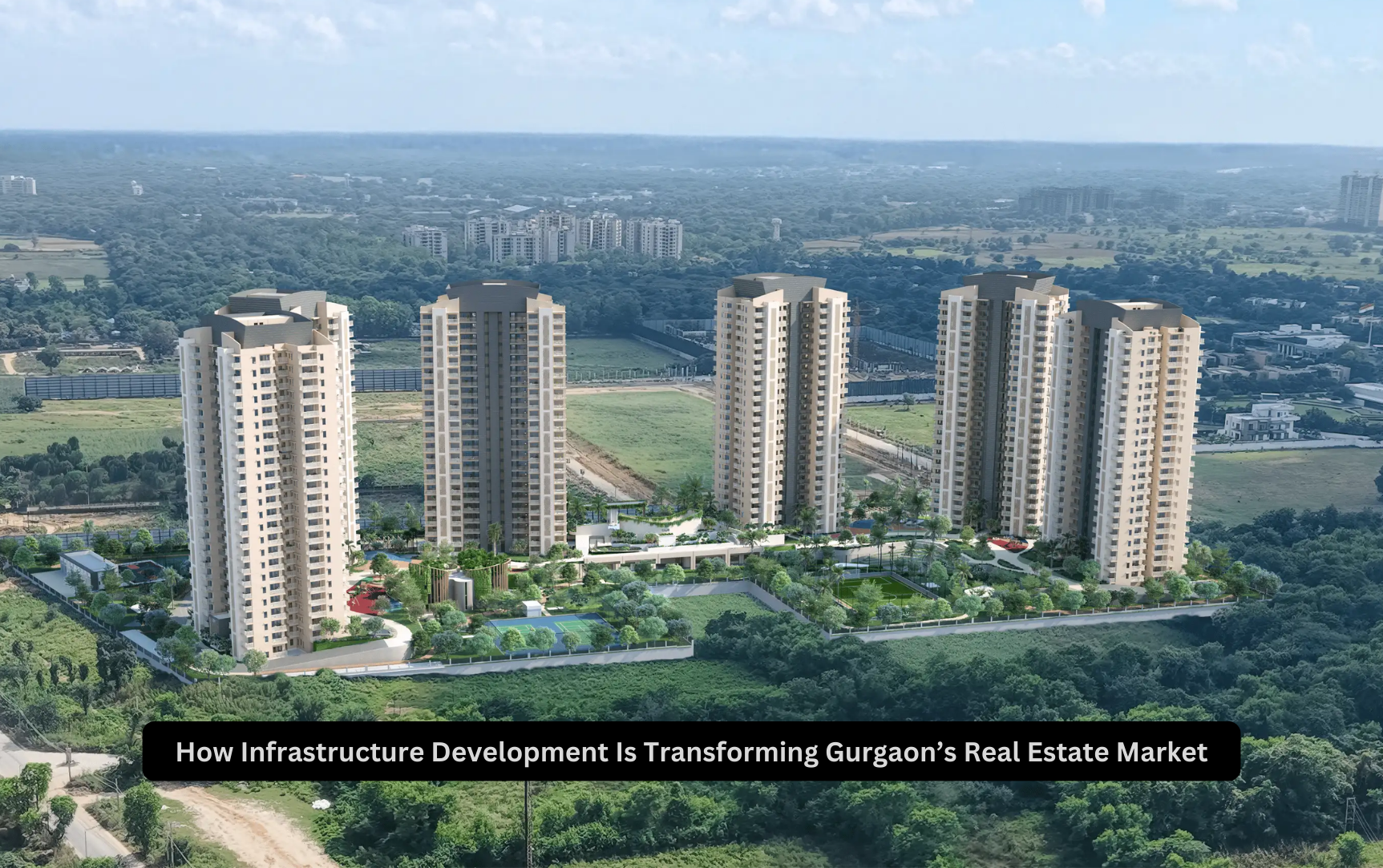
Thoughtfully planned communities, such as those developed by Ashiana Housing, often consider such connectivity corridors crucial for long-term livability. Projects like Ashiana Aaroham are examples of residential developments positioned within well-connected growth zones, aligning with infrastructure-driven expansion.

Sohna Elevated Road: Driving South Gurgaon Forward


Sohna Elevated Road has significantly reduced travel time between Rajiv Chowk and Sohna.

Earlier considered peripheral, Sohna is now integrated into Gurgaon’s urban framework due to:

  • 20-minute connectivity to central Gurgaon.
  • Access to the Delhi-Mumbai Expressway.
  • Proximity to IMT Sohna industrial zone.

This improved infrastructure development has opened affordable yet modern housing options for first-time buyers. Integrated townships and plotted developments are gaining traction in the Gurgaon property market along this belt.

Airport Proximity and Multimodal Advantage


Gurgaon’s closeness to Indira Gandhi International Airport remains one of its strongest real estate advantages.

Upcoming tunnel connections via Dwarka Expressway are expected to reduce airport travel time even further.

This multi-layered connectivity, metro, expressways, and airport access, creates:

  • Strong rental demand from expatriates.
  • Attraction for corporate offices.
  • Higher demand for premium housing.

Infrastructure development here supports both residential and commercial growth simultaneously.

Smart Urban Infrastructure and Social Ecosystem


Urban infrastructure today extends far beyond highways and metro lines. Modern city planning now incorporates EV charging stations, underground power cabling, smart surveillance networks, and sustainable water management systems. In Gurgaon’s newer sectors, these features are steadily becoming standard, reflecting a shift toward smarter and more future-ready urban infrastructure.

At the same time, strong social infrastructure plays an equally important role. The presence of reputed institutions such as Delhi Public School and leading healthcare facilities like Medanta significantly enhances everyday livability. Residential developments that combine seamless connectivity with access to quality education, healthcare, and civic amenities tend to deliver stronger appreciation and maintain healthier occupancy levels compared to standalone projects.

The Bigger Picture: Infrastructure as a Value Multiplier


What truly distinguishes Gurgaon is not merely the pace of construction, but the strategic and coordinated nature of its infrastructure development. Every new expressway, metro expansion, or elevated corridor sets off a chain reaction, unlocking price discovery in emerging sectors, shifting demand toward better-connected locations, stimulating retail and commercial growth, and encouraging fresh residential supply. This cascading impact is a key reason why the Gurgaon real estate market continues to progress more dynamically than many other cities across the NCR.

Conclusion


Infrastructure development is not a supporting factor in Gurgaon’s growth, it is the foundation. From NH-48 and Dwarka Expressway to metro expansions and southern connectivity corridors, every upgrade reshapes the city’s real estate geography.

As urban infrastructure becomes more integrated and future-ready, new micro-markets emerge, property values adjust, and investor interest intensifies. Gurgaon’s journey demonstrates how well-planned connectivity, multimodal transport, and smart city initiatives collectively transform a regional suburb into a thriving real estate powerhouse.

For buyers and investors observing real estate trends, understanding infrastructure development is no longer optional; it is essential to interpreting where the next wave of growth will unfold.

Don't forget to share this valuable article with others

How does infrastructure development impact Gurgaon’s real estate market?

It increases connectivity, boosts demand, and drives steady property value appreciation.

It improves airport access and unlocks premium residential investment corridors.

Metro connectivity increases rental demand and strengthens resale value near stations.

Strategic connectivity, social infrastructure, and upcoming metro integration drive demand.

Coordinated infrastructure projects continuously unlock new sectors and investment opportunities.

About The Author

Ashiana, Ashiana Housing build homes. Homes surrounded by vast green spaces and fresh breeze. Homes cocooned in secured gated complexes. Homes where futures are forged and there are opportunities to grow. And Homes in environments brimming with healthy activity, trust and respect. At heart, we build communities with care.

Other posts by

Free

Subscribe Now to our blog. Stay up to date with the latest real estate market, investment option, updates on senior living & kid centric world & Just enter your email address to subscribe

Join 1000+ of fellow readers. Get expert real estate knowledge straight to your inbox absolutely free. Just enter your email address below.

Get our blogs straight in your inbox,
know real estate better:
en_USEnglish
en_USEnglish

wait your request is under process

Site Visit

wait your request is under process