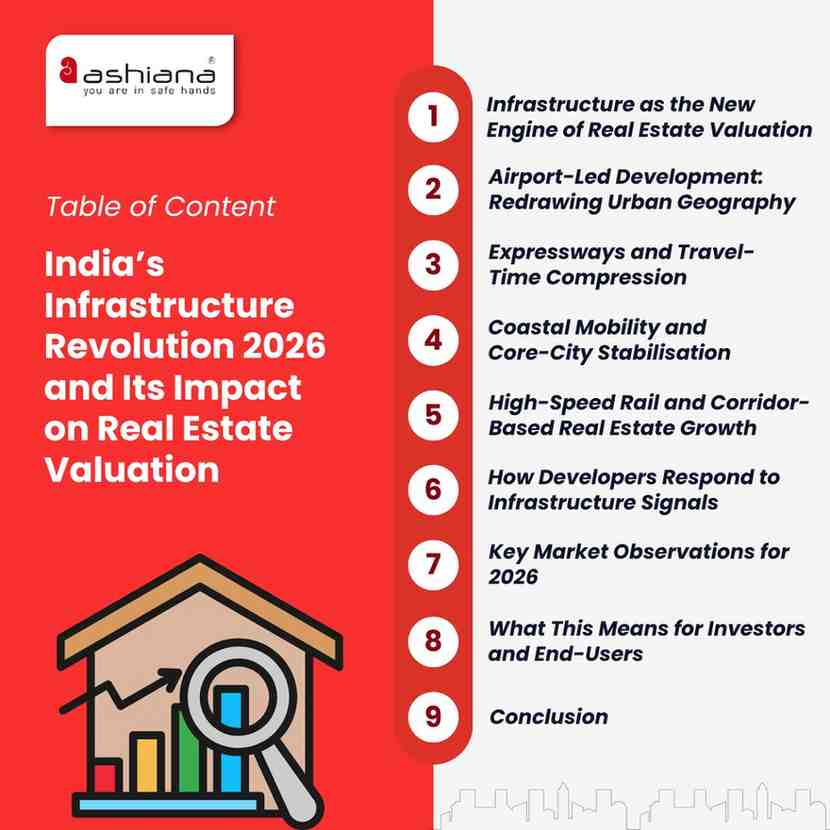
India’s Infrastructure Revolution 2026 and Its Impact on Real Estate Valuation

India is stepping into a defining phase of its infrastructure revolution. Massive investments in airports, expressways, metro corridors, coastal roads, logistics hubs, and high-speed rail are doing far more than improving connectivity. They are fundamentally reshaping real estate valuation across metros and emerging corridors alike.

Today, infrastructure is no longer a background enabler of growth. It directly influences property price trends, buyer psychology, capital allocation, and the pace of real estate growth. What we are witnessing is not just physical expansion, but a structural shift in how property valuation is determined.

India’s Infrastructure Revolution 2026 and Its Impact on Real Estate Valuation

Infrastructure as the New Engine of Real Estate Valuation


In earlier cycles, property appreciation often followed city-wide demand or speculative momentum. In 2026, valuation patterns are becoming more data-driven and location-specific.

When infrastructure improves, several measurable shifts occur:

  • Travel time reduces significantly
  • Employment clusters expand or relocate
  • Peripheral zones become accessible growth corridors
  • Liquidity improves in previously underdeveloped micro-markets

These changes influence property valuation well before projects are completed. In many markets, transaction activity accelerates during the execution phase itself, reflecting investor confidence in future connectivity.

Airport-Led Development: Redrawing Urban Geography


Large airports have historically acted as economic multipliers. The development of Noida International Airport (Jewar), Navi Mumbai International Airport, and other regional upgrades are altering the real estate growth trajectory of surrounding regions.

How Airport Corridors Influence Property Price Trends


  • Land Repricing Begins Early
    As soon as execution becomes visible, land parcels and plotted developments start witnessing recalibration in valuation.

  • Employment-Driven Housing Demand
    Airports attract aviation services, logistics, hospitality, and industrial units. This creates genuine residential absorption based on workforce demand rather than speculation.

  • Logistics and Warehousing Clusters
    Industrial belts aligned with airport corridors experience steady capital inflow, stabilising commercial and mixed-use real estate valuation.
This pattern is already visible along the Yamuna Expressway belt and parts of Navi Mumbai, where micro-markets are transitioning into structured growth corridors.

Expressways and Travel-Time Compression: A Direct Pricing Trigger


One of the strongest drivers of property valuation in 2026 is the reduction in travel time. Even a 20–30 minute cut in commute time can influence willingness to pay.

Projects such as the Mumbai Trans Harbour Link (Atal Setu), the Dwarka Expressway, the Delhi-Mumbai Expressway, and Bengaluru’s peripheral ring roads are altering buyer preferences.

What Changes When Commute Time Drops?


  • End-users reconsider previously “far” locations
  • Rental markets expand outward
  • Commercial leasing spreads to secondary business districts
  • Developers diversify product offerings in newly accessible zones

The psychological shift is critical. When connectivity becomes predictable and efficient, risk perception reduces. This directly supports sustainable real estate valuation growth rather than short-term spikes.

Coastal Mobility and Core-City Stabilisation


Urban coastal road projects in cities such as Mumbai are far more than mobility enhancements. By easing internal congestion and improving east-west connectivity, they are reinforcing the strength of premium micro-markets across South and Central Mumbai.

Better accessibility has deepened demand for well-connected luxury residences, increased enquiry levels for mid-town housing, and reduced the steady outward shift of end-users. As traffic pressure declines, core-city neighbourhoods regain stability, supporting stronger, long-term property valuation in established premium zones.

High-Speed Rail and Corridor-Based Real Estate Growth


The Mumbai-Ahmedabad High-Speed Rail project marks a shift from city-centric valuation to corridor-level economics.

High-speed rail does not simply connect two cities. It activates intermediate nodes.

Emerging Corridor-Level Trends


  • Satellite towns attract residential development
  • Industrial and manufacturing belts see renewed investment
  • Hospitality and commercial segments expand near transit hubs

Locations such as Virar, Boisar, Vapi, and the peripheral belts of Ahmedabad and Surat are witnessing renewed attention. These markets benefit not from isolated triggers but from layered infrastructure integration.

Stacked infrastructure, where rail, highway, industrial corridors, and airport access converge, tends to deliver disproportionate uplift in real estate valuation compared to single-asset triggers.

How Developers Respond to Infrastructure Signals


Infrastructure influences far more than buyer sentiment; it directly shapes how developers plan and invest. Capital allocation trends consistently show stronger launch activity in areas aligned with major infrastructure upgrades. In response, developers recalibrate unit configurations, refine pricing bands, optimise project phasing, and often introduce mixed-use formats that combine residential and commercial components, ensuring their offerings remain aligned with emerging connectivity-driven demand patterns.

Thoughtfully planned residential developers, including players such as Ashiana Housing, often align project planning with long-term livability and infrastructure visibility. Rather than reacting to short-term hype, structured development responds to confirmed mobility upgrades and employment ecosystems.

This disciplined approach reduces volatility in property price trends and supports sustainable real estate growth.

Key Market Observations for 2026


As India’s infrastructure revolution accelerates, certain patterns are becoming clearer:

  • Even a meaningful reduction in commute time can directly influence pricing power and increase transaction activity.

  • Improved connectivity draws businesses, which in turn attract a working population that sustains long-term residential demand.

  • Areas once considered peripheral often evolve into structured growth corridors once major infrastructure becomes operational.

  • The primary uncertainty is rarely demand generation, but delays in execution that can slow the pace of valuation growth.

  • Locations supported by multiple infrastructure triggers, such as airports, expressways, and industrial corridors, tend to demonstrate stronger resilience and long-term returns.

What This Means for Investors and End-Users


For investors, early positioning near confirmed infrastructure assets can offer valuation uplift even before full operational launch. However, due diligence around execution timelines is critical.

For end-users, proximity to job hubs and reliable connectivity ensure not only capital appreciation but also rental viability and liquidity stability.

The era of blind speculation is gradually fading. Real estate valuation is becoming more data-backed, infrastructure-linked, and economically grounded.

Conclusion: Infrastructure Is Redefining Valuation Frameworks


India’s infrastructure revolution in 2026 represents more than physical expansion. It is redefining how cities grow, how demand redistributes, and how real estate valuation is calculated. Connectivity now influences liquidity. Mobility shapes pricing power. Employment ecosystems anchor sustainable appreciation.

Markets that understand these structural shifts, rather than reacting post-completion, are better positioned for long-term stability. As infrastructure continues to expand across airports, highways, coastal corridors, and high-speed rail, India’s property landscape will increasingly be defined by access, integration, and economic alignment.

Don't forget to share this valuable article with others

How does infrastructure development impact real estate valuation?

Improved connectivity boosts demand, liquidity, and long-term property price growth.

Yes, markets often reprice during construction due to future growth expectations.

Better access transforms the outskirts into organised, high-demand growth corridors.

Jobs attract workforce, sustaining housing demand and stabilising valuations.

Project delays can slow appreciation and disrupt expected valuation timelines.

About The Author

Ashiana, Ashiana Housing build homes. Homes surrounded by vast green spaces and fresh breeze. Homes cocooned in secured gated complexes. Homes where futures are forged and there are opportunities to grow. And Homes in environments brimming with healthy activity, trust and respect. At heart, we build communities with care.

Other posts by

Free

Subscribe Now to our blog. Stay up to date with the latest real estate market, investment option, updates on senior living & kid centric world & Just enter your email address to subscribe

Join 1000+ of fellow readers. Get expert real estate knowledge straight to your inbox absolutely free. Just enter your email address below.

Get our blogs straight in your inbox,
know real estate better:
en_USEnglish
en_USEnglish

wait your request is under process

Site Visit

wait your request is under process