Chennai’s GCC Expansion and Its Potential Impact on Real Estate Market
Chennai has long been recognised for its strong manufacturing, automobile, IT, healthcare, financial services, and engineering sectors. In...
Read More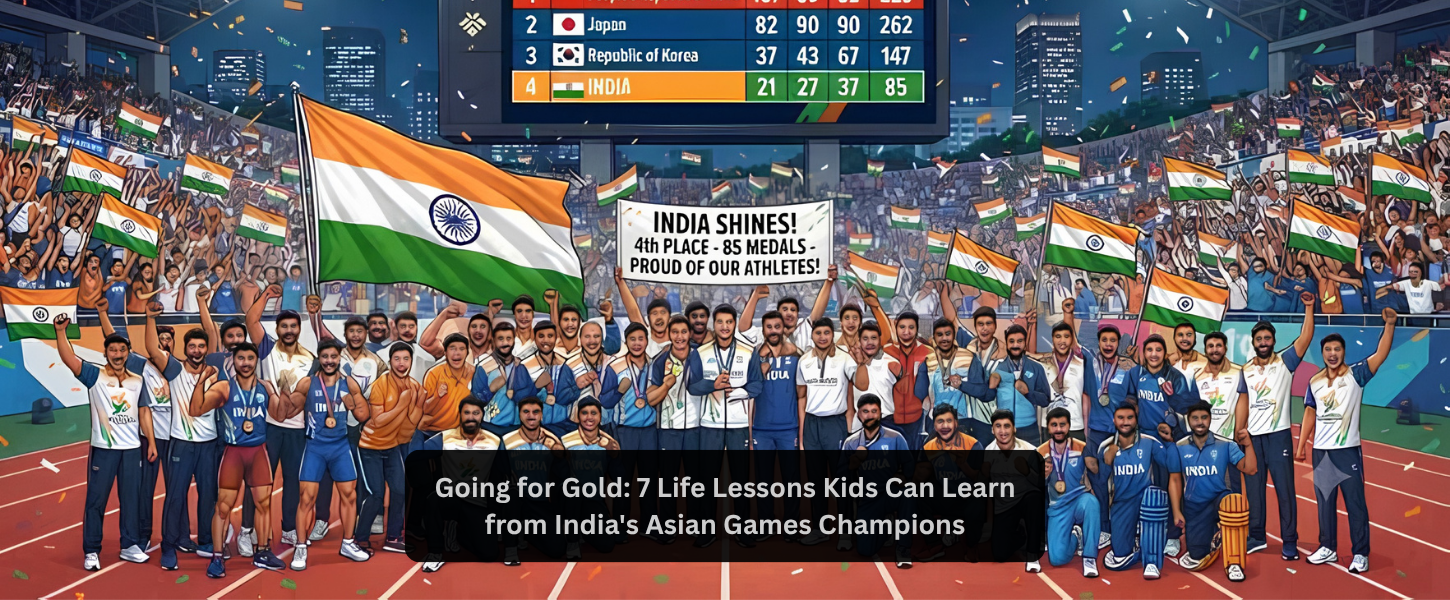

In the early days of October, living rooms across India echoed with cheers. Families gathered around television screens, children waved tiny flags, and a new generation of young viewers watched Indian athletes stand on the podium at the Asian Games in Aichi-Nagoya, Japan.
India finished the 2026 Asian Games in fourth place with 85 medals, including 21 gold, 27 silver and 37 bronze, according to published medal tallies. Behind every one of those medals is a story of discipline, courage, and hard work. For parents, these stories are a gift. They give us a chance to talk to our children about values that matter far beyond the playing field.
Here are seven life lessons that kids can learn from India’s Asian Games champions.
Shooter Neeru Dhanda became the first Indian woman to win an Asian Games shotgun gold, taking the women’s trap title with an Asian record, according to reports from the Games. It was also India’s first trap gold in 48 years.
What kids can learn:
Being the first is never easy, but someone has to be. Encourage your child to dream boldly, even when the path looks unfamiliar. Every big achievement begins with a child who believed it was possible.
In shooting, a tiny shift in breathing or posture can change the outcome. India’s shooters at the Asian Games showed how careful practice pays off. Suruchi Singh and Kamaljeet won India’s first Asian Games gold in the mixed team 10m air pistol event, setting an Asian record along the way.
What kids can learn:
Success is rarely sudden. It is built through small, repeated efforts, whether that means practising handwriting, a musical instrument, or a sport. Praise your child for patience and consistency, not only for results.
Team events at the Asian Games brought some of India’s proudest moments. The Indian men’s and women’s kabaddi teams won gold, and India’s women’s T20 cricket team also finished on top of the podium. Neeru Dhanda also partnered with Kynan Chenai to win India’s first mixed team trap medal, which was gold.
What kids can learn:
No one wins alone. Teamwork means listening, trusting, sharing credit, and supporting each other. Group games, community sports and team activities help children learn these skills early.
In the men’s cricket final, India defeated Pakistan by 19 runs to retain the Asian Games gold medal. Finals bring nerves, noise and high expectations, and champions are those who stay composed when it matters.
What kids can learn:
Pressure is a part of life, in exams, performances and competitions. Teach children simple habits such as deep breathing, positive self-talk and focusing on the next step instead of the final result.
Pranavi Urs won gold in the women’s individual golf event, a sport that many Indian children rarely get to try. Her success is a reminder that talent can be found in places we do not always look.
What kids can learn:
Sport is not limited to the games we see most often. Let children try different activities, from badminton and swimming to pickleball, archery, or golf. Curiosity can lead to unexpected passions.
Of India’s 85 medals at the 2026 Asian Games, 21 were gold, but 27 were silver, and 37 were bronze. Each of these athletes trained for years, travelled across the continent, and represented the country with pride.
What kids can learn:
Winning is wonderful, but effort and perseverance deserve celebration too. Help your child value progress and personal bests. A child who learns to be proud of trying is a child who keeps growing.
Behind the medals, athletes also show us respect for opponents, officials, and teammates. They shake hands, congratulate rivals, and return to training after defeat. Sportsmanship is as important as skill.
What kids can learn:
Playing outdoors, staying active, and learning to win and lose gracefully build both health and character. Make time each day for physical activity, and let your child enjoy sport for its own sake.
No champion is made overnight, and no child can practise without space, safety and encouragement. The environment in which children grow up plays a large role in whether they get to run, play, explore and learn every day.
This is the thinking behind kid-centric homes, a concept pioneered by Ashiana Housing. Rather than treating children as an afterthought, a kid-centric community is planned around their physical, intellectual, and emotional growth. Ashiana’s kid-centric philosophy is built on ideas such as safety first, more learning with less screen time, international-standard sports infrastructure, and a dedicated Learning Hub.
Ashiana Housing has developed kid-centric communities in Bhiwadi, Jaipur and South Gurugram, and has since extended the idea to Gurugram’s newer sectors.
For families inspired by the Asian Games, communities like these show how everyday surroundings can nurture young talent. Children can try football, cricket, basketball, tennis or pickleball within the community, learn alongside neighbours of their own age, and enjoy safe, green open spaces. Parents can be assured that a child’s day, from learning to play, is thoughtfully supported.
For current details on availability, amenities, and pricing, please contact Ashiana Housing or visit their official website.
Here are a few simple ways to carry the spirit of the Asian Games into your child’s daily routine:
The Asian Games remind us that champions are shaped by courage, patience, teamwork and love for the game. As parents, we can help children carry these values into everyday life, through the stories we share, the habits we encourage and the environment we choose for them.
Every child has the potential to go for gold, in sport, in studies or in life. With the right support, a little encouragement and a safe place to play, they can aim as high as they dream.
India finished fourth in the medal table with 85 medals: 21 gold, 27 silver and 37 bronze. It was India’s second-highest tally at the Asian Games, after the 2022 edition.
The 20th Asian Games were held in Aichi and Nagoya in Japan, from 19 September to 4 October
Start with play, let them explore different activities, and focus on enjoyment and effort rather than competition. Easy access to safe, nearby sports spaces makes it much simpler.
Kid-centric homes are residential communities planned around children’s safety, learning, sports, and overall development, with features such as sports facilities, learning hubs, and safe, vehicle-free play spaces.