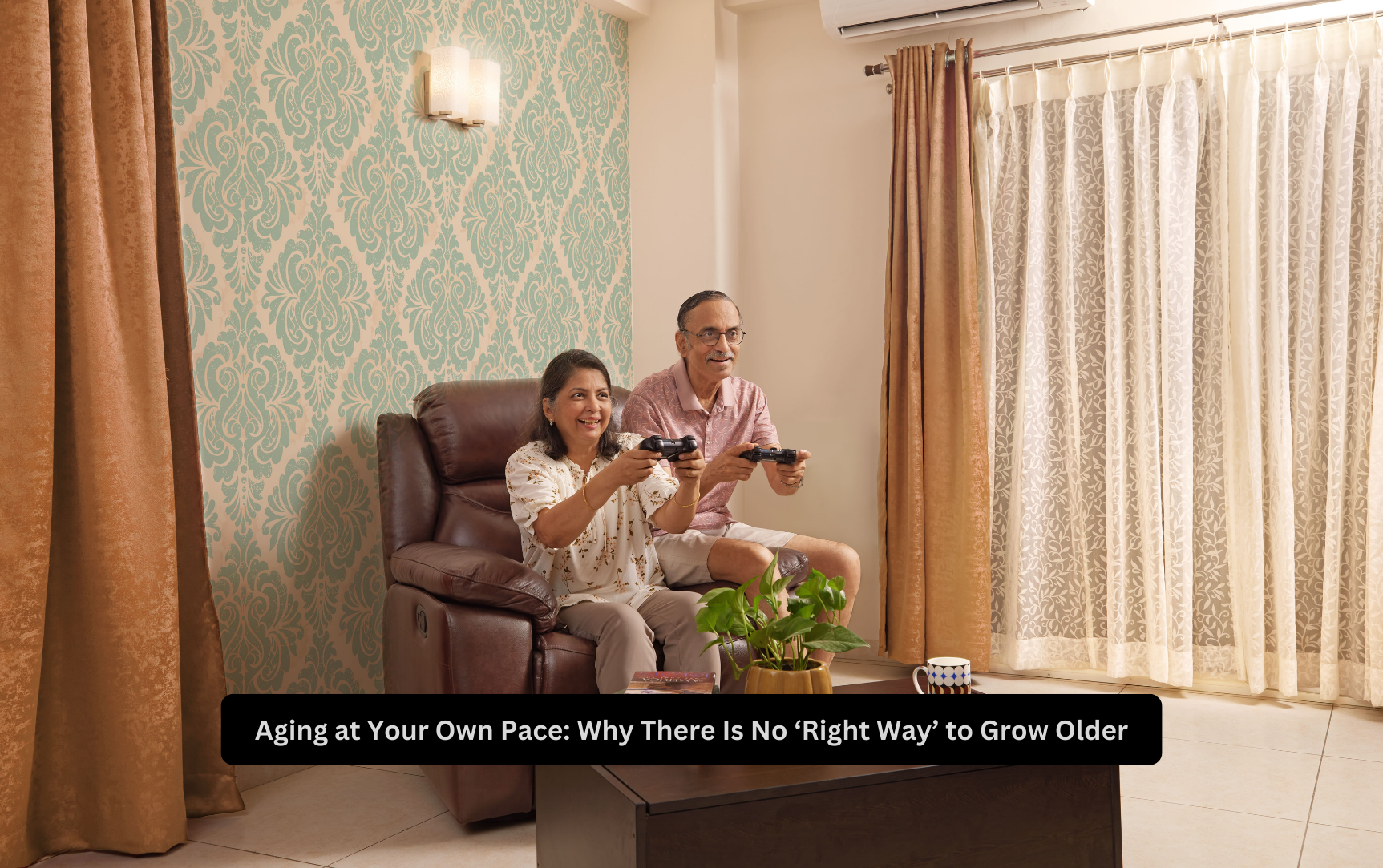
Aging at Your Own Pace: Why There Is No ‘Right Way’ to Grow Older

Somewhere along the way, aging became a performance.

By 30, you’re expected to have a solid job, financial independence, and a clear direction for your life.
By 40, you should have bought a house, built a stable home, and secured your family’s future.
By 50, you’re expected to have a retirement plan in place, accumulated significant assets, and reached peak career stability.
By 60, you should be largely debt-free, financially secure, and gradually stepping back from full-time work.

These quiet social timelines hum beneath our decisions, shaping how we measure ourselves. But aging is not a standardized test, nor is it a linear narrative. It is a deeply personal, biological, emotional, and cultural experience, and there is no single correct way to do it.

The Myth of the “Correct” Timeline


Modern society loves benchmarks. Milestones offer order in an otherwise uncertain world. Yet the idea that there is a universal arc to aging ignores a simple truth: human lives unfold under radically different conditions.

Health, privilege, trauma, opportunity, geography, and culture all influence how we grow older. To assume uniformity is to misunderstand the complexity of being human.

The 45-year-old starting over is not “behind.”
The 70-year-old launching a new career is not “late.”
The 30-year-old prioritizing rest over ambition is not “wasting time.”

Chronological age is a number. Lived age, the accumulation of experiences, losses, reinventions, and recoveries, is far more nuanced.

Biology is Not a Script


Even biologically, aging does not move in lockstep. Research in gerontology consistently shows that individuals age at different rates across cognitive, physical, and emotional domains. Someone may experience physical decline while gaining psychological resilience. Another may feel socially isolated but intellectually sharper than ever.

There is no synchronized decline. No universal moment when vitality fades, or wisdom automatically appears.

In fact, many developmental psychologists argue that later life can bring increased emotional regulation, perspective, and clarity. 

Cultural Narratives Shape Our Fears


In youth-obsessed cultures, aging is often framed as an erosion of beauty, relevance, desirability, and capability. Entire industries are built on the promise of slowing, masking, or reversing time.

Yet in many parts of the world, aging carries authority. Elders are consulted. Wrinkles signify experience, not decline. Gray hair is not corrected; it is respected.

The discomfort around aging often says more about cultural conditioning than about the aging process itself. When we internalize narrow standards such as “stay productive,” “stay attractive,” “stay fast”, we turn aging into a battle instead of a transition. But aging is not something to defeat. It is something to inhabit.

Growth Does Not Expire


One of the most limiting assumptions about aging is that growth belongs to youth. We are told that reinvention is admirable at 25 and irresponsible at 55. That risk-taking has an age limit. That curiosity should taper off.

But human development is not confined to early adulthood. People learn languages at 60. Begin painting at 72. Find love at 80. Recover from long-held emotional patterns in midlife. Discover boundaries after decades of overextension.

Neuroplasticity, the brain’s ability to adapt, does not abruptly disappear. Emotional insight often deepens with time. Patience increases. The need for external validation may soften. Aging can bring fewer illusions and more clarity. And clarity is its own kind of vitality.

Permission to Move at Your Pace


Perhaps the most radical act in aging is refusing comparison. Social media compresses time. We see curated highlight reels of achievement and assume we should be somewhere else by now. But the invisible parts of growth, healing, unlearning, resting, grieving, and rebuilding rarely trend.

There are seasons of acceleration and seasons of pause. Some years expand us and years that quietly repair us. Both are forms of progress.

To age at your own pace means allowing yourself:

  • To evolve without explanation
  • To slow down without guilt
  • To start again without shame
  • To prioritize well-being over optics
  • To define success in changing terms

It means understanding that fulfilment is not limited to a particular age bracket.

Redefining What It Means to “Age Well”


We often equate aging well with preservation, maintaining youthfulness, productivity, or appearance. But perhaps aging well is less about preservation and more about alignment.

  • Are you living in closer accordance with your values than you did a decade ago?
  • Are you more honest with yourself?
  • More compassionate?
  • More discerning about where your energy goes?

If so, you are aging well. Aging at your own pace is not a denial of time; it is cooperation with it. It is recognizing that identity is not static and that change does not invalidate who you were; it expands who you are.

There is No Finish Line


The idea of a “right way” to grow older implies an endpoint- a perfected version of adulthood. But life resists neat conclusions. We are always becoming.

Some people become softer. Others become sharper. Some expand their worlds; others intentionally narrow them. Some accumulate possessions; others shed them. None of these trajectories is inherently superior.

Aging is not a competition. It is an unfolding. And perhaps the quiet wisdom of growing older is this: the urgency to measure yourself against others begins to fade. What remains is a more intimate question, not “Am I on track?” but “Am I aligned?”

There is no universal schedule for meaning. No mandatory pace for reinvention. No prescribed rhythm for fulfillment.

There is only your timeline. And it is enough.

Don't forget to share this valuable article with others

Is it normal to feel “behind” at a certain age?

Yes. Many people internalize social timelines about when certain milestones should happen. Feeling “behind” is often less about personal failure and more about comparison. Growth is not linear, and life circumstances vary widely. There is no universal clock you are required to follow.

Absolutely. Emotional intelligence, resilience, and clarity often deepen with age. The brain retains the ability to adapt, and many people discover new passions, careers, or relationships well beyond traditional “milestone” years. Growth does not expire; it simply changes form.

Aging well is less about preserving youth and more about living in alignment with your evolving values. It may mean prioritizing health, setting stronger boundaries, cultivating meaningful relationships, or redefining success on your own terms. It is a personal standard, not a societal one.

Comparison often stems from exposure to curated narratives of success. Limiting external noise, focusing on your lived experiences, and reflecting on how far you’ve come can help shift perspective. Remember that unseen struggles and seasons of healing are also valid forms of progress.

No. Reinvention is not age-bound. Whether it’s changing careers, pursuing education, healing old patterns, or redefining identity, transformation can happen at any stage of life. There is no deadline for becoming more aligned with who you are meant to be.

About The Author

Ashiana, Ashiana Housing build homes. Homes surrounded by vast green spaces and fresh breeze. Homes cocooned in secured gated complexes. Homes where futures are forged and there are opportunities to grow. And Homes in environments brimming with healthy activity, trust and respect. At heart, we build communities with care.

Other posts by

Free

Subscribe Now to our blog. Stay up to date with the latest real estate market, investment option, updates on senior living & kid centric world & Just enter your email address to subscribe

Join 1000+ of fellow readers. Get expert real estate knowledge straight to your inbox absolutely free. Just enter your email address below.

Get our blogs straight in your inbox,
know real estate better:
en_USEnglish
en_USEnglish

wait your request is under process

Site Visit

wait your request is under process